
01 YOUR DETAILS
METRIC ONLYA starting point, not a rule.
DETAILS ENTERED
Complete every field to see your estimates.
Your fat-loss target needs an individual review. Please speak with a dietitian.
THE NUMBERS BEHIND YOUR CALORIE ESTIMATEWe blend two resting-energy equations, then adjust for your normal day and weekly exercise. Open the breakdown to see how your daily calories are calculated.
A transparent blend.
We average Mifflin–St Jeor and revised Harris–Benedict equally. This blend is a design choice, not a clinically validated improvement over the individual equations.
Your combined activity multiplier is 1.45. The resting-energy equations do not prescribe a multiplier for each number of sessions. We combine normal daily movement and exercise into a practical estimate within the calculator’s existing 1.2–1.9 range. The range below shows disagreement between equations, not a confidence interval.
Enter your details to compare estimates.
| Mifflin–St Jeor | — |
|---|---|
| Revised Harris–Benedict | — |
| Blended resting estimate | — |
Equations: Calculator.net. Their settings offer individual equation selection; this calculator uses the blend described here.
THE NUMBERS BEHIND YOUR PROTEIN ESTIMATEProtein guidance, food ideas and the evidence behind the daily range.
Support muscle
Protein supports muscle repair and growth alongside strength training. More isn’t always better. [1]
Keep muscle during fat loss
Getting enough protein helps protect muscle when eating fewer calories. Some athletes need a higher target. [2]
Spread it across meals
Include protein across your daily meals. Food can cover your needs; shakes are an optional convenience. [3]
Build meals around protein
A few everyday options to mix and match:
- Chicken & lean meat
- Fish & tinned tuna
- Eggs
- Milk & yoghurt
- Tofu
- Lentils & beans
Protein amounts vary by food and portion. Food guide
THE PROTEIN EVIDENCE
Our starting range is a practical interpretation. The Morton et al. meta-analysis (2018) estimated a muscle-gain plateau near 1.6 g/kg/day, with considerable uncertainty. It studied resistance training without calorie restriction, so this is not a universal ceiling or a fat-loss prescription.
The Nunes et al. review (2022) also found small additional lean-mass benefits from more protein alongside resistance training. The ISSN position statement (2017) suggests 1.4–2.0 g/kg/day for most exercising adults; AIS guidance gives 1.6–2.4 g/kg/day for athletes losing weight. These recommendations address different contexts.
If you have kidney disease, a prescribed diet, or a body weight that makes this calculation unsuitable, ask a dietitian for an individual target.
PROTEIN FOODS AT A GLANCE
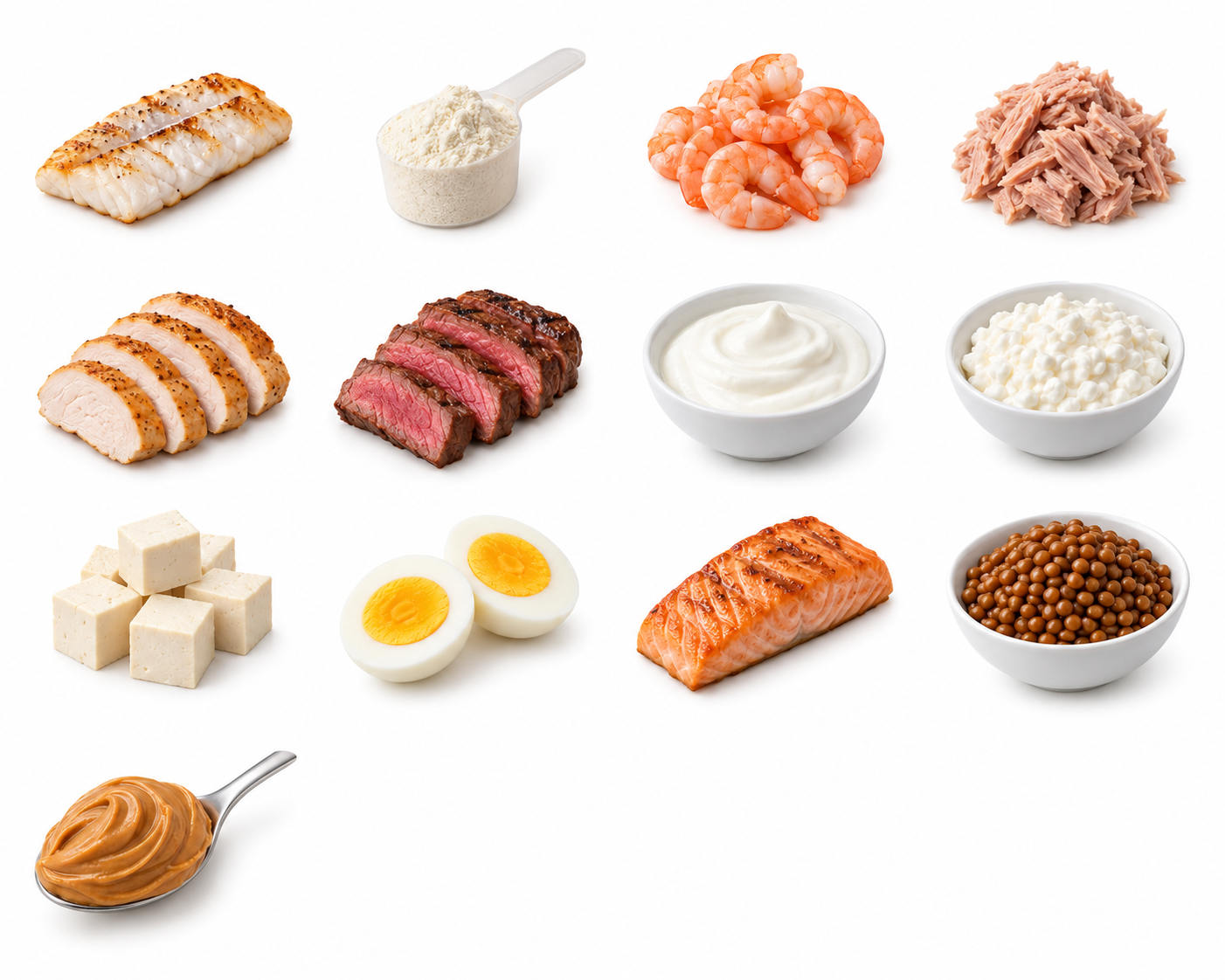
WHAT DOES 30 G OF PROTEIN LOOK LIKE?
Every option below provides about 30 g of protein. Compare the food amount and calories to see which choices give you more protein for fewer calories.
MORE PROTEIN FOR FEWER CALORIES
-
1
 Baked King George whiting
106 gAbout 1 small fillet
131kcal
22.8 gprotein / 100 kcal
Baked King George whiting
106 gAbout 1 small fillet
131kcal
22.8 gprotein / 100 kcal
-
2
Whey protein powder
35 g powderAbout 1 scoop
132kcal
22.7 gprotein / 100 kcal
-
3
Cooked prawns, peeled
111 gRoughly 7 large prawns
134kcal
22.4 gprotein / 100 kcal
-
4
Tuna in water, drained
115 gAbout 2 small cans, drained
148kcal
20.2 gprotein / 100 kcal
-
5
Baked chicken breast
103 gAbout half a large breast
157kcal
19.0 gprotein / 100 kcal
-
6
Lean rump steak
94 gAbout 1 small palm-sized steak
159kcal
18.9 gprotein / 100 kcal
-
7
Natural light Greek yoghurt
323 gAbout 1⅓ cups
181kcal
16.6 gprotein / 100 kcal
-
8
Cottage cheese
176 gRoughly ¾ cup
235kcal
12.8 gprotein / 100 kcal
-
9
Firm tofu
234 gAbout half a 450 g block
304kcal
9.9 gprotein / 100 kcal
-
10
Hard-boiled eggs
About 5 eggsRoughly 242 g edible weight242 g edible weight
329kcal
9.1 gprotein / 100 kcal
-
11
Atlantic salmon
131 gAbout 1 small fillet
338kcal
8.9 gprotein / 100 kcal
-
12
Cooked lentils
411 gAbout 2 cups cooked
378kcal
7.9 gprotein / 100 kcal
-
13
Peanut butter
124 gAbout 6 tablespoons
775kcal
3.9 gprotein / 100 kcal
The same 30 g of protein can come with very different food amounts and calories.
Approximate edible weights. Preparation, brand and protein-powder formulation can change the numbers. Generic foods use the Australian Food Composition Database; yoghurt uses its manufacturer label.
PUT IT ON YOUR PLATE
3 DAYS OF MEAL IDEAS.
Example portions based on your calories and protein range. Adjust your details above to update the plan. Spread the snacks across your day; chocolate or ice cream can be dessert.
Mixed-diet examples with wheat, dairy, fish, shellfish, eggs, soy, peanuts and tree nuts. Check ingredients for allergies. These are meal ideas, not a complete personalised nutrition prescription.
PORTIONS & NUTRITION ESTIMATES
Meat, fish, rice, pasta, lentils, potatoes and vegetables are weighed cooked; tuna is drained. Oats are dry, bread is weighed before toasting, eggs are peeled and fruit is edible weight. A chicken breast or steak varies in size: use the cooked gram weight shown. Oil, spreads and treats are included; extra sauces, drinks and ingredients change the totals.
Main meat and seafood portions stay between 150 and 250 g cooked. Rice, pasta and potatoes stay at or below 300 g cooked per meal; oats stay between 40 and 80 g dry. Portions adjust across all four meals towards your calorie estimate and protein range. These are practical menu limits, not recommended serving sizes for everyone. When the examples cannot match your targets within these limits, we say so.
Nutrition values were checked on 12 September 2026 against Food Standards Australia New Zealand’s Australian Food Composition Database, Release 3. Yoghurt uses the Chobani Natural Light label; chocolate uses the Cadbury Dairy Milk label. Vanilla ice cream is the database’s regular-fat example. Check your own pack: brands, meat cuts and cooking methods change the numbers.
Carbs are available carbohydrate, excluding fibre, consistent with Australian food labelling. Database energy includes fibre; kilojoules are converted to kcal by dividing by 4.184. Fibre, food components and label rounding mean calories may differ from protein × 4 + carbs × 4 + fat × 9. Totals use the actual displayed portions and unrounded nutrition values, so rounded ingredient totals can differ slightly. These examples do not assess all vitamin, mineral or fibre requirements.
For adults aged 18–80. Not for pregnancy or breastfeeding. If you have a medical condition, a history of disordered eating, or need an individual nutrition plan, speak with a qualified health professional. About calorie-estimate limitations.